Randomly selected records from this database. Refresh the page for a different sample.
| Business Name | Phone | Address | Rating | Google Profile |
|---|---|---|---|---|
| VIDYA INTERNATIONAL SCHOOL | 25592***** | GAT. NO. 74 DHANORE, Yeola, Dhanore, Maharashtra 423401, India | View Profile | |
| Big Dreams Preschool and Montessori Teacher Training Academy -Top & Best Montessori teacher training Academy in Nashik | 77096***** | Landmark- Near Anna house of Dosa, Animesh Shubhash Complex, road, Gangapur Rd, behind Akashwani Tower, Purnvad Nagar, Nashik, Maharashtra 422013, India | View Profile | |
| Radiant International School For Excellence (RISE) | 70304***** | 698/3, Agra - Mumbai Rd, near NH3, Pimpalgaon Baswant, Maharashtra 422209, India | View Profile | |
| Al Kabir English Medium School | 77097***** | HHF7+G4P, Daregaon, Malegaon, Maharashtra 423105, India | View Profile | |
| Mount Litera Zee School (MLZS) - Malode Vasti | 86559***** | Plot No 891, Shertati Road, Malode Vasti, Adgaon, Nashik, Maharashtra 422003, India | View Profile | |
| KIDZEE pre-school, Indira nagar, parab ngr. Nashik 422009 | 89997***** | Gajra nisarg, phase 2, Khode mala parisar Parab nagar, Indira Nagar, Nashik, Maharashtra 422009, India | View Profile | |
| Little Blossoms School | 72767***** | Magh Sector, Sundar ban Colony, MF-78, near Shiv Ganesh Temple, Shanti Nagar, Lekha Nagar, Nashik, Maharashtra 422009, India | View Profile | |
| Maple Leaf Pre-School | 90674***** | Wasan Toyota showroom, Subodh House, 911/2, behind wasan Toyota showroom, Wasan Nagar, Pathardi Phata, Nashik, Maharashtra 422009, India | View Profile | |
| Happy KIDS School | 72495***** | ShivGanga Rowhouse No3, ShivGSwami Samarth Nagar, Agra - Mumbai Rd, near Hanuman Temple, behind Jatra Hotel, Swami Samarth Nagar, Vrindavan Nagar, Nashik, Maharashtra 422003, India | View Profile | |
| Satyam International School | 80070***** | A/19,Rajya Karmchari Housing Society, Police Chowki, near Ashoknagar, Ashoknagar, Satpur Colony, Nashik, Maharashtra 422012, India | View Profile |
The information contained in this Schools and Preschools Database Nashik is collected from publicly available business sources, directories, websites, and online listings.
Link Kart provides business data for lead generation, sales prospecting, market research, and B2B marketing purposes only.
We do not provide private, confidential, or sensitive personal information. Users are responsible for complying with applicable laws and marketing regulations when using this data.
By purchasing or downloading this product, you acknowledge that the data is provided for legitimate business purposes only and agree to our Disclaimer, Terms & Conditions, and Return Policy.
The Schools and Preschools Database Nashik from Link Kart is designed for businesses that want to identify educational institutions in Nashik and develop a structured list of potential business prospects. Schools and preschools represent a distinct audience for companies offering educational supplies, classroom equipment, furniture, learning materials, technology solutions, and other institution-focused services. A category-specific database helps businesses concentrate their prospecting efforts on this relevant audience instead of spending time sorting through unrelated business listings.
For sales teams, distributors, manufacturers, and service providers, finding suitable institutions is an important part of building a consistent B2B pipeline. A structured database brings available business information together in a format that can support prospect research, contact planning, and territory-based sales activities. Link Kart provides business data intended to help companies identify potential customers and organize their outreach according to their commercial objectives.
The Schools and Preschools Database Nashik focuses on educational institutions within the specified city market. It can be useful for businesses that already serve the education sector as well as companies exploring opportunities to supply products or services to schools and preschools.
Rather than treating every institution as an equally suitable prospect, businesses can use the available details to determine which records align with their offerings, service coverage, and sales priorities. This makes the database a practical resource for focused B2B research and business development.
This product is a single-category, city-specific business database focused on schools and preschools in Nashik. It is intended for buyers seeking educational institution records in a defined local market, rather than a broad database covering unrelated businesses across an entire city or state.
The dataset is compiled from publicly available business sources, which may include business directories, search engines, public business listings, and other open web sources. The information available for individual institutions depends on what can be found in those sources.
The purpose is to help businesses identify relevant educational establishments and organize the available information for prospecting and market research.
Schools and preschools have different operational requirements, purchasing priorities, and service needs. A preschool may require early-learning materials, child-friendly furniture, educational toys, and classroom resources. A school may have requirements involving desks, laboratory equipment, digital learning tools, stationery, infrastructure support, or institutional software.
A category-focused database helps suppliers narrow their research to institutions that may be relevant to their products. However, inclusion in the database does not automatically mean that an institution needs a particular product or is currently looking for a supplier. Businesses should assess suitability through their own research and sales qualification process.
The city-specific scope is useful for companies that sell within Nashik, assign sales representatives to local territories, or distribute products across selected regional markets. Businesses can concentrate on records associated with Nashik rather than sorting through institution listings from multiple unrelated locations.
For companies serving a wider geographical area, this product can also contribute to a broader Maharashtra Schools and Preschools Database strategy when combined with suitable datasets for other locations.
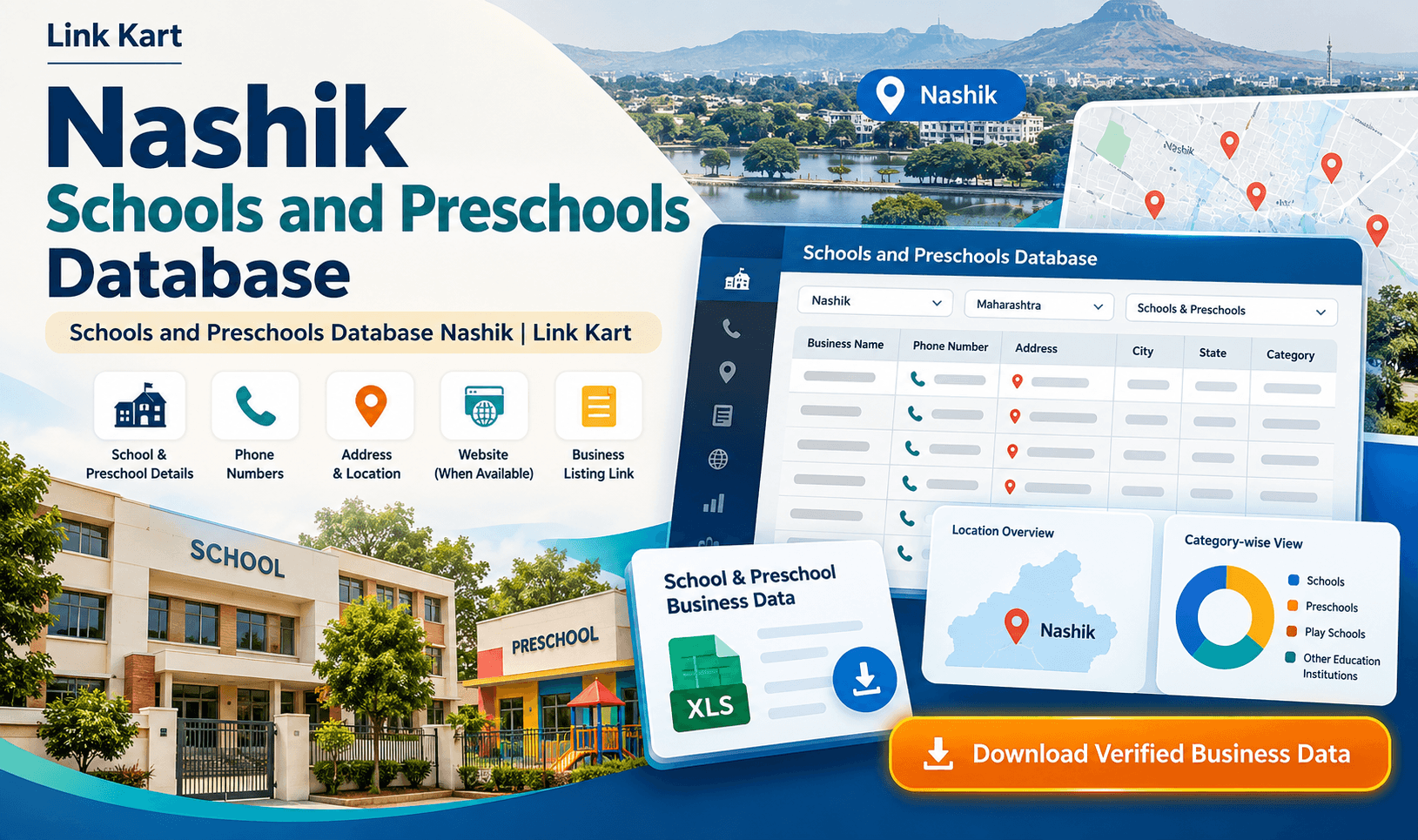
Useful prospecting begins with having enough information to identify an institution and understand its location. The Schools and Preschools Database Nashik may include the following fields, depending on source availability and the individual record.
Business Name: The listed name of the school or preschool.
Phone Number: A publicly listed contact number, where available.
Address: The available business or institutional address.
City and State: Geographic information to support location-based organization.
Pin Code: Available postal information for territory planning.
Category: The listed business or institution category.
Website: The institution's website, when available.
Latitude and Longitude: Geographic coordinates, where available.
Business Profile or Listing Link: A link to an available public business profile or listing.
Not every record will necessarily contain every field. Public listings can vary in their level of detail, and some institutions may have limited online information.
Phone numbers can help sales teams initiate relevant business conversations, identify the appropriate purchasing contact, and understand whether an institution may be suitable for a particular offering. For example, a supplier of classroom furniture could contact an institution to enquire about its procurement process, while an educational technology provider could investigate whether its solutions fit the institution's requirements.
The presence of a phone number should not be interpreted as permission for unrestricted promotional calls. Businesses are responsible for following applicable Indian telecommunications, privacy, and commercial outreach requirements, including relevant consent, preference, and do-not-disturb rules.
Businesses can use available location and category fields to organize prospect records according to their internal workflow. Depending on the team's needs, records may be grouped by area, institution type, sales territory, or product suitability.
Before importing any dataset into a customer relationship management system or another sales platform, review the available columns, remove duplicate records where appropriate, and establish a process for recording contact outcomes. This helps teams maintain an orderly prospecting process without assuming that every listed institution is a qualified lead.
The database is relevant to businesses whose products or services are designed for educational institutions. Its value depends on how closely a company's offering matches the requirements of the schools and preschools it identifies.
Companies selling notebooks, stationery, writing materials, teaching aids, classroom supplies, art materials, and other educational products can use Schools and Preschools Business Leads Nashik to identify institutions for potential distribution and sales opportunities.
A distributor can review the available records, determine which institutions fall within its delivery area, and prioritize outreach according to product range, order requirements, and business capacity.
Manufacturers and dealers of desks, chairs, storage units, classroom furniture, playground equipment, and other institutional products may use the database to develop a prospect list for local sales activities.
The information can help vendors identify institutions to research before presenting product catalogues or arranging sales discussions. Specific purchasing requirements, budgets, and procurement timelines must still be established directly with each institution.
Businesses offering school administration software, classroom technology, digital learning systems, attendance solutions, and related services can use institution records as a starting point for market research.
A technology provider might classify prospects according to the type of institution served by its product, its supported geographical area, and the features relevant to its customers. The database helps identify possible prospects, but it does not establish which institutions currently use competing systems or intend to purchase new technology.
Educational publishers, children's book distributors, worksheet providers, and companies producing age-appropriate learning resources may find the database useful for identifying institutions that could be relevant to their product range.
Preschools and other educational establishments may have different requirements based on their teaching approach and student age groups. Sales teams should confirm these details during their research and conversations rather than assuming identical needs across all records.
Companies offering cleaning services, facility maintenance, safety equipment, infrastructure support, and other institution-oriented services may also use the database to identify potential business accounts.
For these buyers, the practical benefit is having a structured starting point for identifying local institutions, evaluating their relevance, and planning business development activities.
A database creates commercial value when it supports a clear process. Businesses can incorporate the Nashik Schools Contact Database into their existing sales operations in several ways.
Start by identifying the products or services that the business wants to sell. A company supplying preschool learning materials may prioritize preschools, while a vendor specializing in laboratory equipment may focus its research on schools with relevant facilities.
Review the available category, business name, and location details to identify records worth investigating. Where the listing does not provide enough information, consult the available public business profile or other legitimate sources before prioritizing the prospect.
Businesses operating through field representatives can use address, city, pin code, and available geographic coordinates to organize prospecting areas. This can support route planning, territory allocation, and the grouping of potential customers for local sales visits.
Geographic fields may vary in completeness, so addresses and coordinates should be checked before being used for navigation or operational planning.
Manufacturers and wholesalers often need to identify institutions that may purchase products through a distributor or local dealer. The database can help them research the potential customer base within Nashik and organize institution records for further qualification.
Companies can use this starting list to identify areas for market coverage, prepare sales materials, and develop a consistent process for approaching suitable institutions.
The database can be used as an initial prospecting resource alongside a CRM or spreadsheet-based workflow. After reviewing each record, a sales team can maintain its own fields for qualification status, outreach date, discussion outcome, next action, and sales representative.
These internal fields are part of the buyer's sales process rather than guaranteed fields in the supplied database. Keeping the two separate helps businesses distinguish the source information from their own research and sales activity.
Businesses looking for potential customers often face a practical challenge: general business listings can contain organizations that have little connection to their products or services. A category-specific database offers a more focused starting point by concentrating on a defined type of institution within a particular geographical market.
Link Kart's Schools and Preschools Database Nashik is intended for businesses researching this particular customer segment.
The focus on schools and preschools helps buyers begin with a business category that matches their intended market. This can reduce the initial effort involved in separating educational institutions from unrelated businesses, although individual records still require review and qualification.
A Nashik-focused database is useful for companies whose sales strategy depends on local presence, regional distribution, or city-level prospecting. Teams can organize the available records around their service areas and determine which institutions merit further investigation.
The available business information can support prospect research, account identification, territory planning, and the development of internal sales lists. Businesses can use the records alongside their existing CRM, sales reporting, and customer qualification processes, subject to the dataset's format and available fields.
The database should be viewed as a prospecting resource, not a guarantee of sales opportunities. A listed institution may not require the buyer's product, may already have a supplier, or may have incomplete contact information. Its role is to help businesses identify possible accounts and decide where further research and direct qualification are worthwhile.
Business databases compiled from public sources require realistic expectations. Different schools and preschools maintain different levels of online visibility, and public listings may contain missing fields, outdated details, duplicate entries, or inconsistent naming.
Link Kart's database is compiled from publicly available business information. Buyers should assess the supplied coverage and available fields against their intended use rather than assuming that every institution in Nashik is represented or that every record contains a complete set of details.
For practical use, businesses should consider three aspects of data quality.
Record identification: Check that the institution's name and location correspond to the intended business account.
Contact usability: Review available phone numbers and other contact details before beginning outreach. Where appropriate, use public listings to confirm important information.
Commercial relevance: Determine whether the institution is a suitable prospect based on its apparent profile, the products or services offered, and the business's own sales criteria.
These checks help businesses use the School and Preschool Business Directory Nashik responsibly and distinguish a potential lead from a confirmed sales opportunity. Buyers should also follow applicable requirements for personal data, telecommunications, and commercial communications.
Finding relevant educational institutions is an important first step for companies seeking to build relationships with schools and preschools. A structured database can help reduce the initial research effort by bringing available business information into a focused, location-specific resource.
With Link Kart's Nashik Schools and Preschools Database, suppliers, distributors, manufacturers, and service providers can begin identifying potential institutional customers, organize local prospecting activities, and develop a repeatable approach to business development.
Whether the objective is to introduce educational supplies, research demand for classroom equipment, explore institutional technology opportunities, or expand local distribution, the database provides a starting point for investigating relevant business accounts. Its practical usefulness will depend on the available records, the buyer's target market, and the quality of the subsequent qualification process.
Businesses seeking a Preschool Contact Database Nashik or a Nashik School Phone Number Database can use this category-focused product to explore publicly available institution information where relevant fields are present. For companies expanding beyond one city, the same approach can form part of a broader Maharashtra Schools and Preschools Database strategy, using separate location-specific resources where available.
Explore the Schools and Preschools Database Nashik from Link Kart to support focused B2B research, local sales planning, and the identification of potential education-sector customers.
The Schools and Preschools Database Nashik is a city-specific business data product from Link Kart focused on educational institutions in Nashik. It is designed to help suppliers, distributors, manufacturers, and service providers identify potential institutional customers using available public business information.
Depending on source availability, records may include institution name, phone number, address, city, state, pin code, category, website, geographic coordinates, and a public business profile or listing link. Individual records may not contain every field, so buyers should review the available data before use.
The database may be useful for educational supply distributors, classroom furniture vendors, publishers, learning material providers, school software companies, technology suppliers, and institutional service providers. Businesses can use it to identify relevant prospects and plan sales research according to their products, service areas, and target customer requirements.
Complete coverage of every institution should not be assumed. The database is compiled from publicly available sources, and coverage depends on the information available for individual businesses. Phone numbers and other details may be missing or require confirmation, so buyers should assess coverage and verify important records before outreach.
Yes, the database can support prospect research, local sales planning, distributor development, and targeted business outreach to relevant educational institutions. Businesses should qualify each prospect according to their own requirements and follow applicable privacy, telecommunications, and commercial outreach regulations when using publicly available contact information.
Start by reviewing the available fields, checking important contact details, and removing duplicate records where appropriate. Organize suitable institutions by location, category, or sales territory, then track qualification status and outreach outcomes in your internal workflow. This approach helps distinguish source data from independently confirmed sales opportunities.
Tell us the category, city, state, or industry you want to target. Our team will help you find the right data for your outreach plan.