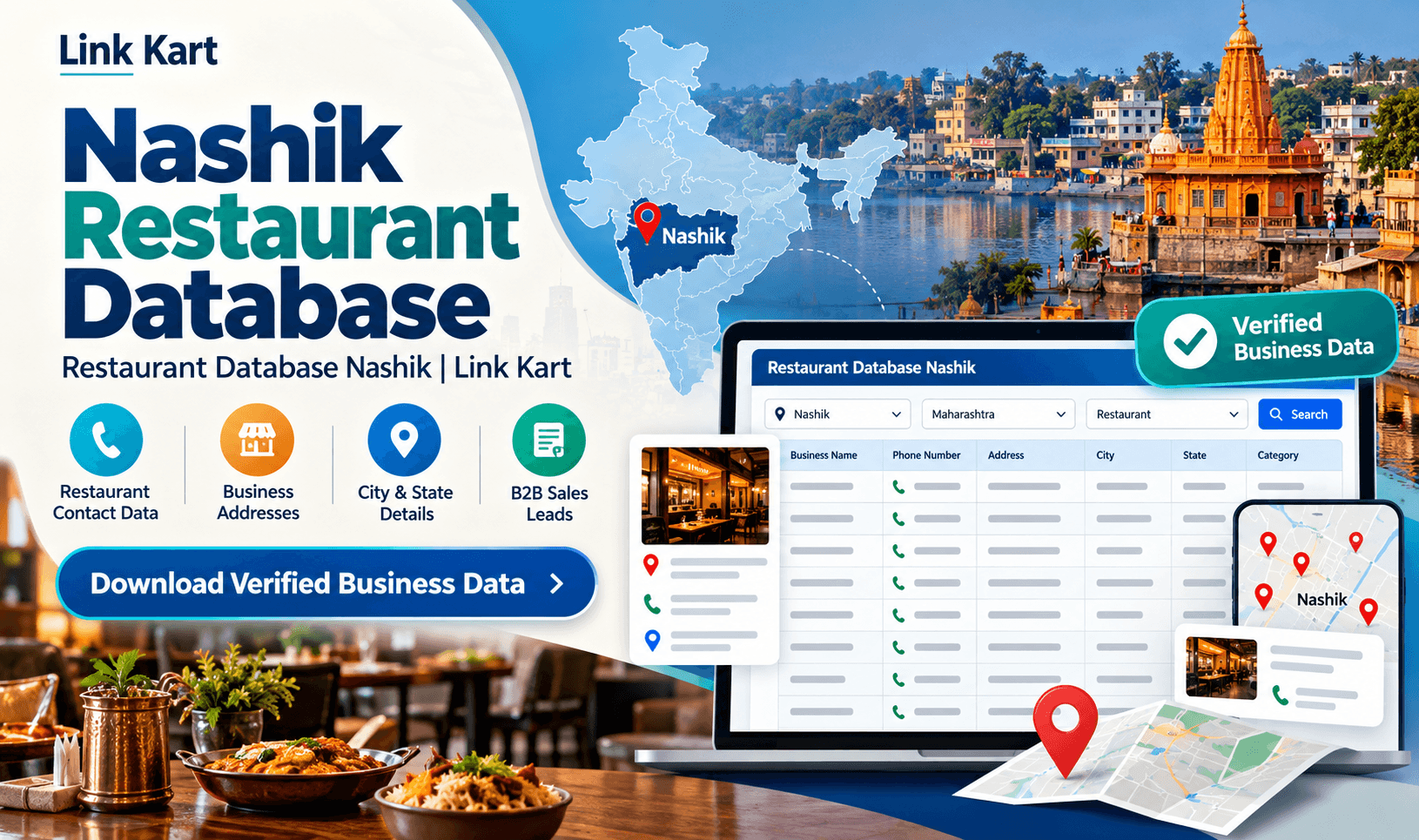
Randomly selected records from this database. Refresh the page for a different sample.
| Business Name | Phone | Address | Rating | Google Profile |
|---|---|---|---|---|
| Gurukrupa Khanaval, Sinnar | 95278***** | Suryodaya Sankul, Bus Stand, behind Sinnar, Sinnar, Maharashtra 422103, India | View Profile | |
| Goli Vadapav | 22668***** | 69, Trimurti Chowk, Cidco, Patil Nagar, Nashik, Maharashtra 422008, India | View Profile | |
| Samarkand Restaurant | 25323***** | Agra - Mumbai Hwy, Kamod Nagar, Indira Nagar, Nashik, Maharashtra 422009, India | View Profile | |
| Annapurna Parcel Point | 86249***** | Shop no 5, Ami Sagar Society, Ambad Link Rd, opp. Burkule Hall, Uttam Nagar, Nashik, Maharashtra 422010, India | View Profile | |
| Maharaja Hotel and Bar | 77768***** | 1, Dindori Rd, Swadya Nagar, Vaiduwadi, Nashik, Maharashtra 422004, India | View Profile | |
| Hotel Baithak Permit Room And Beer Bar | 88058***** | National Highway No-3, Pimpalgaon Baswant, Maharashtra 422209, India | View Profile | |
| Ayyanar Dosa Point | 98220***** | XQW7+5C9, P&T Colony, Nashik, Maharashtra 422002, India | View Profile | |
| Pawan Tea House | 77768***** | Shop No 27, Shankar Nagar, Nashik, Maharashtra 422011, India | View Profile | |
| Hotel Swad Gharcha | 97635***** | Shop Nob5, near Ozhar, Bajrang, Airport, Nashik, Ojhar, Maharashtra 422207, India | View Profile | |
| Balaji panipuri House | 91308***** | Shop no. 2, prabha anand society, chavan mala behind bytco college, Gayakhe Colony, Nashik Road, Nashik, Maharashtra 422101, India | View Profile |
The information contained in this Restaurant Database Nashik is collected from publicly available business sources, directories, websites, and online listings.
Link Kart provides business data for lead generation, sales prospecting, market research, and B2B marketing purposes only.
We do not provide private, confidential, or sensitive personal information. Users are responsible for complying with applicable laws and marketing regulations when using this data.
By purchasing or downloading this product, you acknowledge that the data is provided for legitimate business purposes only and agree to our Disclaimer, Terms & Conditions, and Return Policy.
Finding relevant restaurant businesses is an important part of building a focused B2B sales pipeline. For companies that supply food products, commercial kitchen equipment, restaurant packaging, cleaning materials, and hospitality services, reaching the right restaurant businesses can help improve sales prospecting and market development.
The Restaurant Database Nashik from Link Kart is a city-specific business data resource designed to help businesses identify restaurant prospects across Nashik, Maharashtra. It brings together restaurant business information collected from publicly available sources, such as business directories, search engines, public business listings, and other open web sources.
Instead of researching individual restaurant listings one at a time, businesses can use a Restaurant Database Nashik to organize prospect research around a specific industry and geographical market. This approach can support structured telephone outreach, territory planning, account research, and business development activities.
The database focuses on the restaurant category rather than covering every type of business in Nashik. This makes it relevant to companies whose products or services are specifically intended for restaurant operators and related food-service businesses.
Link Kart helps B2B sales teams explore restaurant business information in a more organized way, allowing them to identify relevant prospects and plan their outreach according to their commercial objectives.
The Nashik Restaurant Database is a single-category, city-focused business database. Its primary purpose is to help users discover restaurant businesses associated with Nashik rather than provide a comprehensive database of every business category in the city or throughout Maharashtra.
Restaurant businesses may have different operating models, customer segments, and purchasing requirements. A supplier serving independent restaurants, for example, may approach prospecting differently from a company selling equipment or services to larger food-service operations.
A dedicated restaurant database provides a starting point for organizing these prospects by available business details and location.
Depending on the information available in the underlying public sources, database records may include:
Business Name: The listed name of the restaurant or business establishment.
Phone Number: A publicly available business contact number, where listed.
Address: The available business location details.
City and State: Geographical information to support local market segmentation.
Pin Code: A postal location field where available.
Category: The listed business category associated with the establishment.
Website: A business website address, where available.
Latitude and Longitude: Geographic coordinates where available.
Business Profile or Listing Link: A reference to the available public business listing, where included.
The presence of optional fields depends on the source information available for each record. Not every restaurant listing will necessarily contain every field.
These details can help sales representatives research prospective accounts, identify businesses within a target territory, and organize a working list of potential customers.
Local market knowledge is useful when businesses want to expand their customer base without approaching unrelated companies. A location-specific database helps narrow prospecting to a defined commercial area and a relevant business category.
For suppliers targeting restaurants, the Nashik market can be approached through business information associated with the city and its surrounding commercial demand. The value of this approach depends on the fit between a supplier's offering and the needs of each restaurant.
A Nashik Restaurant Business Leads list can help businesses develop a prospecting plan around their intended service area. Sales teams can review available addresses, city details, and other listing information to organize their research and prioritize accounts that fit their distribution or service capabilities.
For example, a food distributor may focus on restaurants it can serve through its existing delivery network. A kitchen equipment supplier may investigate establishments that match its product range and service coverage.
A restaurant-specific prospect list helps businesses begin with a defined audience instead of an unrestricted list of companies. Sales representatives can research each establishment before making contact, understand the products or services they offer, and prepare a relevant introduction.
The database does not establish whether a restaurant is currently purchasing a particular product or looking for a supplier. Those requirements should be confirmed through direct communication.
Business addresses and postal information can help teams group prospects by geographical area, subject to the completeness of available records. This may be useful for planning sales visits, coordinating representatives, or organizing regional distribution activities.
A structured territory plan can also make it easier to review which accounts have been researched, contacted, or scheduled for follow-up.
The Restaurant Contact Database Nashik is relevant to businesses that sell products or services to restaurant establishments. Its practical usefulness depends on whether the buyer's offering aligns with the restaurant category and the business's intended operating territory.
Food distributors, packaged food suppliers, and beverage product companies can use restaurant business information to identify potential commercial accounts. A restaurant prospect list provides a starting point for researching establishments that may be relevant to their product portfolios.
Before approaching a prospect, distributors can review the business listing, assess its apparent suitability, and confirm purchasing requirements directly.
Manufacturers and distributors of takeaway packaging, food containers, paper products, and related supplies may use restaurant leads to identify potential buyers. Businesses can organize their prospect research according to location and then investigate which establishments match their product specifications and supply arrangements.
The database can support prospect discovery, but it does not confirm the purchasing volume or packaging requirements of individual restaurants.
Companies supplying cooking equipment, refrigeration systems, kitchen tools, and food preparation machinery may use a restaurant database to develop a list of businesses for further research.
Restaurant names, addresses, public phone numbers, and listing references, where available, can help sales teams identify prospective accounts and determine the appropriate next step for each business.
Suppliers of commercial cleaning products, sanitation materials, pest management, maintenance, and related services can use restaurant business leads to explore potential customers in their service area.
A location-focused database can help organize prospecting, while individual business needs, service requirements, and purchasing authority must be established separately.
Hospitality consultants, business development agencies, and sales outsourcing companies may use restaurant listings for market research and account discovery. The information can help them identify relevant establishments, structure outreach campaigns, and maintain an organized prospect pipeline.
Any outreach should be relevant to the business contacted and comply with applicable calling, privacy, and marketing requirements.
Phone-based prospecting can be an important part of B2B sales when the product or service requires a direct conversation. A Restaurant Phone Number List Nashik can help businesses identify publicly listed contact numbers where available, providing a starting point for sales research and telephone outreach.
The effectiveness of phone prospecting depends on preparation, contact accuracy, timing, and the relevance of the offer.
Sales teams can use the database to establish a structured process for approaching prospective restaurant customers.
A practical process may include:
Review the available restaurant business details and identify prospects that fit the target market.
Check the public business listing and available contact information before outreach.
Prepare a short introduction that explains the product or service and its relevance to the restaurant.
Record the outcome of each call in the company's own sales tracking system.
Schedule appropriate follow-ups where the business expresses interest or requests additional information.
This process helps separate researched prospects from contacted accounts and reduces unnecessary repetition.
A phone number alone does not establish that a restaurant needs a product or that the person answering the call makes purchasing decisions. Sales representatives should verify the business identity and explain the reason for contacting it.
When a call reaches the wrong person, representatives can ask whether another department or contact handles the relevant purchasing decision. They should respect requests not to be contacted and follow applicable communication rules.
Where a business profile or listing link is available, representatives can use it to review the public information associated with a prospect. A website or listing may provide additional context about the establishment, its services, or its operating model.
This research can make initial conversations more relevant without assuming that every business has the same needs.
A Nashik Restaurant Company Database can help businesses organize their prospect research around available location and category information. Segmentation allows sales teams to create working groups based on commercial relevance rather than treating every restaurant as an identical opportunity.
Available city, address, and pin code fields can help users arrange prospects according to their intended coverage area. Businesses may use this information to plan local sales visits, coordinate representatives, or assess whether a prospective account falls within their delivery and service boundaries.
Location fields should be reviewed for completeness before being used for routing or territory assignments.
Restaurant businesses can have different operating needs depending on their format, menu, services, and purchasing arrangements. Where the available category or listing information supports further identification, sales teams can research which prospects are relevant to a particular product.
For instance, a supplier of commercial refrigeration equipment may prioritize restaurants whose operations fit its offering, while a packaging supplier may investigate businesses that provide takeaway services.
These are research and qualification decisions rather than guaranteed attributes of the database records.
Businesses can incorporate relevant database information into an internal sales process, subject to the applicable usage terms and data-handling requirements. A simple pipeline might distinguish between prospects awaiting research, businesses contacted, qualified opportunities, and accounts requiring follow-up.
Maintaining these distinctions helps teams measure their own prospecting activity and avoid assuming that every listed restaurant is an active sales opportunity.
Restaurant B2B Leads Nashik can support several commercial activities when used as a prospect discovery resource. The appropriate application depends on the company's target audience, available sales capacity, and product-market fit.
Businesses entering or expanding within Nashik can use restaurant records to identify establishments for initial research. This is particularly relevant to suppliers that need to develop a list of potential business accounts before beginning direct sales activities.
The database provides a starting point for finding prospects; it does not guarantee customer interest, conversion, or sales.
Manufacturers and distributors can use restaurant business details to research potential outlets for new products. Sales teams may organize accounts by location, assess their suitability, and contact relevant businesses to understand their requirements.
This can support a more systematic approach to identifying prospective stockists, buyers, or commercial customers where the product is suitable for restaurant operations.
Businesses can review the available restaurant listings to understand the types of establishments represented in their working prospect pool. This may help them plan research, identify areas for additional prospect discovery, and develop questions for customer conversations.
However, a business database should not be treated as a complete census of the restaurant market. Public listing coverage can vary, and the number of records alone does not establish total market size or purchasing demand.
Sales managers can use a restaurant prospect database to assign research responsibilities, organize calling activities, and maintain account-level notes in their own systems. This can improve visibility into prospecting work and help teams coordinate their efforts.
The database is most useful when combined with consistent internal processes for validating information, recording outcomes, and reviewing account suitability.
Businesses researching restaurant prospects should distinguish between a city-specific database and a broader state-level resource.
A Maharashtra Restaurant Database is intended to address a wider geographical scope across the state, whereas Restaurant Database Nashik focuses on restaurant businesses associated with a particular city.
For companies that operate locally, a Nashik-specific list can help narrow research to a defined market. It may be useful for businesses with local distribution, city-level sales representatives, or service operations concentrated in Nashik.
Companies expanding across multiple markets may need a broader state-level dataset or separate city-specific prospect lists. The appropriate coverage depends on the company's distribution network, sales capacity, and intended customer base.
A city-focused database should not be interpreted as covering every restaurant in Nashik or every restaurant across Maharashtra. The available listings depend on the public sources used to compile the records and the information accessible for individual businesses.
Business data is a starting point for prospecting, not a substitute for account qualification. Before using a Restaurant Database Nashik in a sales operation, buyers should understand the available fields, intended use, and limitations of publicly sourced information.
First, review the fields supplied with the database and determine which are necessary for the intended workflow. A phone-based sales team, for example, may prioritize business names, available phone numbers, addresses, and listing references.
Second, confirm the relevance of individual records before contacting a business. Public listings can change as establishments relocate, update their details, or cease operating. Available contact information may therefore require independent verification.
Third, establish a clear process for handling prospect information. Teams should use the data for appropriate business purposes, observe applicable legal requirements, and respect requests to stop further contact.
Finally, assess the database according to how well its available information supports the intended sales process. The value of a prospect list comes from its relevance to the buyer's business, the quality of subsequent research, and the team's ability to turn suitable prospects into meaningful conversations.
Link Kart provides business data resources to help companies discover prospective B2B customers and organize their sales research. The Restaurant Database Nashik is intended for businesses looking to identify restaurant establishments within a defined city market rather than search through unrelated business categories.
Whether you supply food products, restaurant packaging, kitchen equipment, cleaning materials, or hospitality services, a category-specific database can provide a practical foundation for local prospect discovery.
By combining available restaurant business details with independent verification, relevant sales messaging, and a structured follow-up process, businesses can use the database to support their customer acquisition and market development activities.
Explore the Restaurant Database Nashik from Link Kart to assess its available business fields and suitability for your B2B sales objectives.
The Restaurant Database Nashik is a city-specific business data resource focused on restaurant establishments in Nashik, Maharashtra. It is compiled from publicly available business sources and can help B2B companies identify prospective restaurant customers for sales research, business development, and local market outreach.
Depending on the source, records may include business name, publicly listed phone number, address, city, state, pin code, category, website, geographic coordinates, and business profile or listing link. Optional fields are not available for every record, so buyers should review the supplied data fields before use.
Food distributors, beverage suppliers, restaurant packaging companies, commercial kitchen equipment vendors, cleaning product suppliers, hospitality service providers, and B2B sales teams may benefit from these leads. The database helps them discover relevant restaurant prospects and organize outreach according to their products, services, and operating territories.
No database can guarantee that every publicly listed contact remains current. Phone numbers and business details may change after publication. Available information should be checked against current public listings or confirmed directly with the business before being used for sales calls or other commercial communication.
The Restaurant Database Nashik focuses on restaurant businesses associated with Nashik, making it relevant to city-level prospecting. A Maharashtra Restaurant Database has a broader state-level scope. Businesses can choose the geographical coverage that aligns with their distribution network, sales territories, and customer acquisition plans.
Yes, available public business phone numbers can support relevant B2B telephone prospecting. Before calling, verify the business details and prepare an appropriate introduction. Ensure that outreach follows applicable communication laws and requirements, and respect requests not to be contacted. The database does not guarantee interest or sales conversions.
Tell us the category, city, state, or industry you want to target. Our team will help you find the right data for your outreach plan.